
If you work from home — or spend most of your day parked in front of a screen — you already know the guilt that creeps in around 3 PM when your step counter is still stuck in the triple digits. Walking pads have exploded in popularity over the past couple of years for exactly this reason. They’re smaller, lighter, and far less intimidating than a traditional treadmill, and the best ones slide right under your standing desk or tuck beneath the sofa when you’re done.
But here’s the thing: not all walking pads are created equal. Some are flimsy imports that struggle under a moderate stride. Others promise “brushless motors” that turn out to be marketing fiction. And a few genuinely excellent models deliver smooth, quiet, durable performance at surprisingly fair value.
We spent weeks digging into specs, reading motor teardown reports, studying real user reviews, and cross-referencing expert testing data to find the walking pads that actually deliver. Below, you’ll find our seven top picks for 2026, followed by a no-nonsense buyer’s guide so you know exactly what to look for.

UREVO SpaceWalk 5L Smart Walking Pad
View on AmazonThe UREVO SpaceWalk 5L is the walking pad we’d recommend to most people, and for good reason. It manages to hit a sweet spot between build quality and verified performance that’s genuinely hard to find in this category. Unlike many budget walking pads that make dubious “brushless motor” claims, the SpaceWalk 5L’s motor has been physically verified via label inspection: it runs a 735W brushless motor rated at S1 continuous duty, producing 0.99 CHP. That’s a meaningful distinction when you’re planning to walk on this thing for hours every day.
UREVO’s companion app adds useful features like world-tour walking routes, rhythm-based HIIT programs, and workout tracking that syncs with popular health platforms. The nine-level auto incline (up to 9%) is a standout feature — it lets you simulate hill walking, which significantly increases calorie burn without pushing your speed above a comfortable pace. The multi-layer shock absorption system and high-strength alloy frame contribute to a stable, sturdy feel underfoot, even for heavier users.
What We Like
- Verified brushless motor — not just marketing
- Auto incline up to 9% — rare at this level
- 400-lb capacity speaks to frame quality
- Whisper-quiet operation for office use
- Feature-rich app with route simulations
Worth Noting
- At ~50 lbs, it’s heavier than ultra-slim pads
- Max speed of 4 mph limits light joggers
- Packaging can be tough to open

WalkingPad A1 Pro Foldable Treadmill
View on AmazonWalkingPad (by KingSmith) essentially invented the folding walking pad category, and the A1 Pro remains one of the most refined options you can buy. What sets it apart from the sea of look-alikes is its build quality and the brand’s transparency about motor specs — KingSmith is one of the few walking pad manufacturers that publishes real CHP figures, and the A1 Pro delivers a verified 1.25 CHP continuous-rated brushless motor. That’s meaningfully more power than most competing walking pads.
The A1 Pro’s signature FootSense technology automatically adjusts speed based on your position on the belt — walk toward the front and it speeds up; drift toward the back and it slows down. It’s surprisingly intuitive once you get the hang of it. The wider, longer walking surface gives more room than most compact pads, and multi-layer cushioning makes extended sessions comfortable on joints. The foldable design with built-in wheels means it collapses for storage under furniture.
What We Like
- Premium build quality and polished design
- FootSense auto-speed adjustment
- Larger walking surface than most pads
- Verified motor specs from the manufacturer
- App and remote control included
Worth Noting
- No incline adjustment
- Premium positioning vs. feature-similar competitors
- App pairing can be finicky at first

GoPlus 2-in-1 Folding Treadmill with Dual Display
View on AmazonIf you want a machine that doubles as both an under-desk walking pad and a light running treadmill, the GoPlus 2-in-1 is a standout choice. It features a foldable handlebar design — fold it down for under-desk walking mode, flip it up for a brisk walk or light jog with something to hold onto. This dual-mode approach makes it significantly more versatile than a pure walking pad.
The quiet 2.25HP motor handles both walking and jogging without complaint. The dual display system shows your metrics whether the handlebar is up or down — a thoughtful detail that many 2-in-1 models overlook. Bluetooth connectivity lets you play music through the built-in speaker, and there’s a phone holder for entertainment during longer sessions.
What We Like
- True 2-in-1: walking pad mode and treadmill mode
- Higher max speed allows light jogging
- Dual display — metrics visible in both modes
- Bluetooth speaker and phone holder
- Outstanding value for features offered
Worth Noting
- 265-lb weight limit is lower than competitors
- No incline feature
- Belt can feel narrow for taller users when jogging

DeerRun Q2 Urban Smart Walking Pad
View on AmazonDeerRun has rapidly become one of the most visible walking pad brands, and the Q2 Urban is their sweet spot — it gives you a 6% manual incline while undercutting most flat-only competitors on cost. At roughly 35–38 pounds and just under 4.5 inches tall, it’s genuinely slim enough to stash under a bed, sofa, or desk. The incline adds meaningful intensity to walks without requiring higher speeds, which is a huge advantage for anyone working at a standing desk.
There’s one important caveat: independent teardowns have revealed that DeerRun’s motor is a brushed PMDC unit, despite marketing that sometimes implies otherwise. In this category, a brushed motor is perfectly expected and not necessarily a drawback — just be aware that “brushless” claims from budget brands should be taken with a grain of salt. The Q2 Urban also connects to DeerRun’s PitPat app for tracking workouts, and it comes in a rose gold finish if you want something a little different.
What We Like
- 6% incline at an entry-level tier
- Extremely lightweight and portable
- Available in rose gold and black
- Companion app with workout tracking
- 60-day return window from DeerRun
Worth Noting
- Brushed motor despite some brushless marketing
- App requires phone download to activate
- Lower motor power than premium options

Sperax Walking Pad
View on AmazonThe Sperax Walking Pad is the definition of no-frills fitness. At just 45 pounds with built-in transport wheels, it’s one of the easiest walking pads to move, store, and forget about when you’re not using it. There’s no Bluetooth, no app integration, and no fancy workout programs. What you get instead is a reliable belt, a straightforward LED display, and an RF remote that doesn’t require line-of-sight pointing — a genuinely useful feature when you’re multitasking at your desk.
*Advertised specs — testers have noted the lightweight build may not fully support these claims.
The Sperax requires a “moving start” — you turn on the belt and then step onto it, which takes a session or two to get used to. The belt is on the narrower side at 15.25 inches, so you’ll want to stay focused on your foot placement during the first few walks. It also includes a goal-setting countdown feature where you can set a target for calories or distance and watch it count down as you walk — a simple but effective motivator.
What We Like
- RF remote works without pointing
- Extremely simple — plug in and walk
- Lightweight, easy to move and store
- Goal countdown feature for motivation
- Quiet enough for video calls
Worth Noting
- Narrow belt (15.25″) can feel tight
- No Bluetooth, no app, no incline
- “Moving start” takes adjustment
- Advertised specs may be optimistic
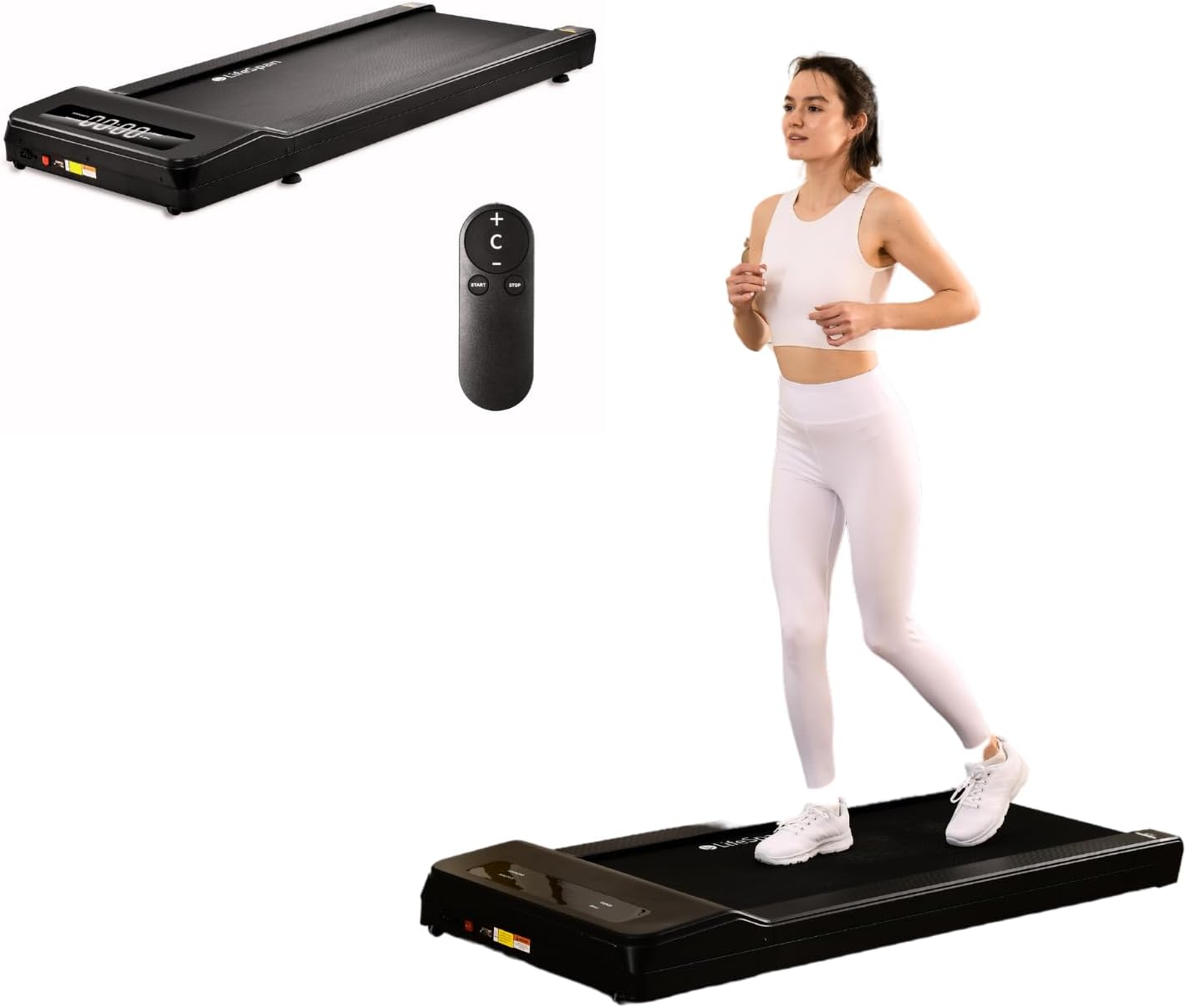
LifeSpan TR5000-DT3 Under-Desk Treadmill
View on AmazonThe LifeSpan TR5000 is in a completely different league from the rest of this list — and its positioning reflects that. This is a commercial-grade under-desk treadmill built for people who are serious about all-day walking. Where most walking pads are designed for a couple of hours of use per day, the TR5000 is rated for up to nine hours of continuous daily operation. It’s the machine offices buy when the whole team wants a turn.
The 3.0 CHP brushless motor drives a generous 20″ × 50″ walking belt — wide enough for any natural gait and long enough that you’ll never feel like you’re running out of room. The phenolic deck is the same material used in commercial gym treadmills, built to absorb thousands of hours of foot strikes. LifeSpan’s DT3 console sits on your desk and displays speed, distance, calories, time, and step count, with integrated Intelli-Step technology for accurate pedometer data. At 119 pounds, this isn’t something you’ll be sliding under the couch — it’s a permanent fixture.
What We Like
- Commercial-grade durability — rated 9 hrs/day
- Verified 3.0 CHP brushless motor
- Widest, longest belt on this list
- 10-year frame warranty
- Desk console with step tracking
Worth Noting
- Significantly more expensive
- 119 lbs — not portable
- No incline adjustment
- Requires dedicated space
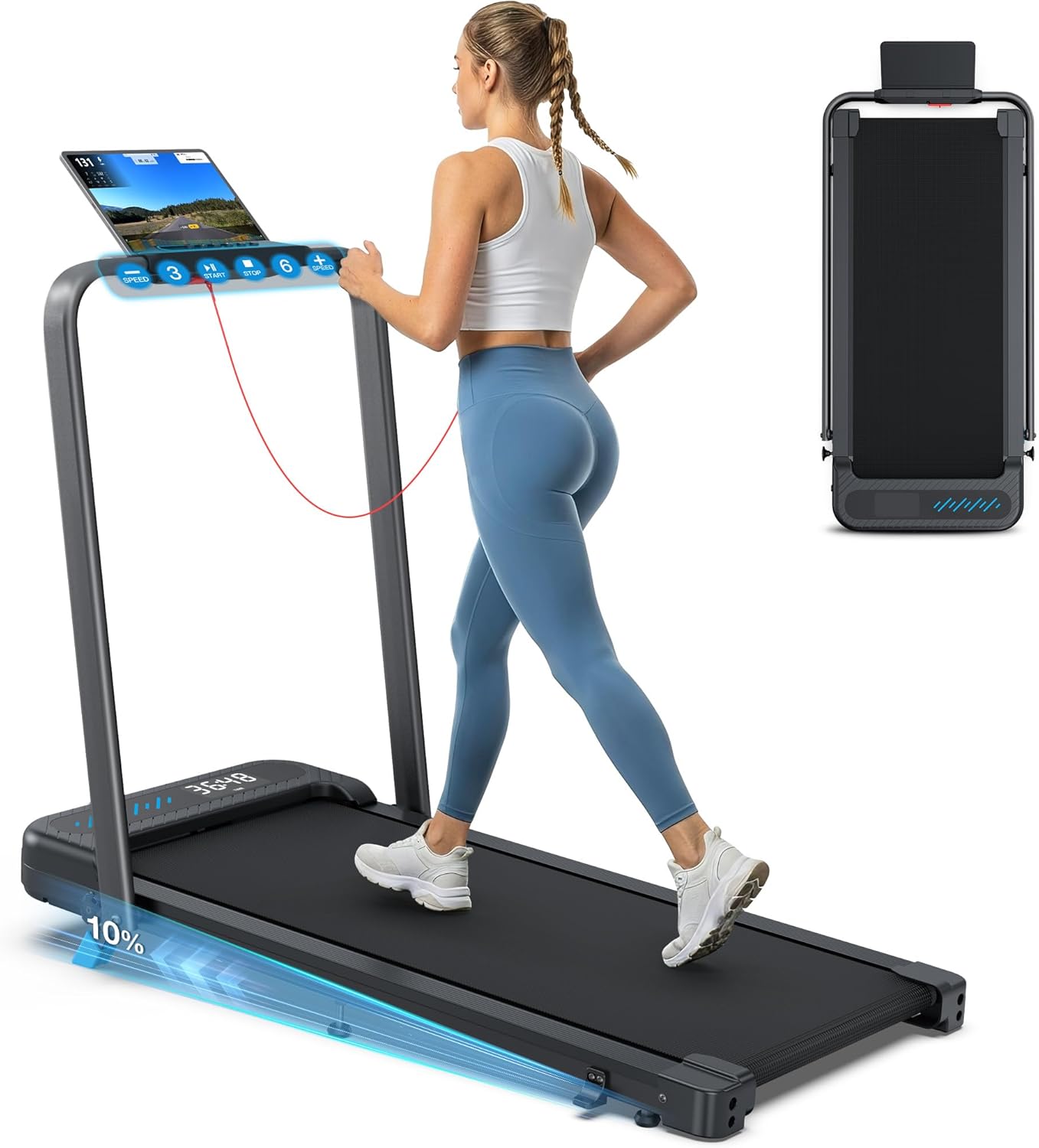
WellFit TM037 Walking Pad
View on AmazonThe WellFit TM037 has built a strong reputation as one of the most reliable options in the ultra-budget walking pad category. It delivers a clean LED display, a wearable remote control, and impressively quiet operation that multiple reviews peg at under 45 decibels. For the money, it’s a lot of walking pad.
In the spirit of transparency: independent motor teardowns have confirmed that the TM037 uses a brushed PMDC motor (0.75 CHP), despite some “brushless” claims in the marketing. For this category, a brushed motor is the norm, and the TM037’s motor performs well for moderate daily walking. It folds for convenient storage, and the wearable remote lets you adjust speed without reaching for a separate controller. If you’re dipping your toes into the walking pad world and don’t want to commit a large budget, this is a solid entry point.
What We Like
- Excellent value for the money
- Quiet operation — great for offices
- Wearable remote control
- Compact, foldable design
- Simple setup out of the box
Worth Noting
- Brushed motor despite some marketing claims
- Lower weight capacity (265 lbs)
- No incline option
- May not hold up to heavy daily use long-term
Quick Comparison: All 7 Walking Pads at a Glance
| Model | Motor | Max Speed | Weight Limit | Incline |
|---|---|---|---|---|
| UREVO SpaceWalk 5L | 2.5 HP (0.99 CHP verified) | 4 mph | 400 lbs | 9% auto |
| WalkingPad A1 Pro | 1.25 CHP verified | 3.7 mph | 300 lbs | None |
| GoPlus 2-in-1 | 2.25 HP | 7.5 mph | 265 lbs | None |
| DeerRun Q2 Urban | ~0.6 CHP (brushed) | 5 mph | 300 lbs | 6% manual |
| Sperax Walking Pad | 2.5 HP (advertised) | 3.8 mph | 320 lbs | None |
| LifeSpan TR5000-DT3 | 3.0 CHP brushless | 4 mph | 400 lbs | None |
| WellFit TM037 | ~0.75 CHP (brushed) | 3.8 mph | 265 lbs | None |
Walking Pad Buyer’s Guide: What Actually Matters
Shopping for a walking pad can feel overwhelming — there are hundreds of options on Amazon alone, many of which look identical and make similar claims. Here’s what to focus on when evaluating your options.
Motor Type and Power
This is arguably the most important spec and the one most frequently misrepresented. Walking pad motors come in two types: brushed and brushless. Brushless motors last longer, run quieter, and generate less heat — but they also cost more to manufacture. Many budget brands claim “brushless” motors that independent teardowns reveal to be standard brushed units. Look for brands that publish real CHP (Continuous Horsepower) figures and ideally have third-party motor verification. For casual daily walking, 0.5–1.0 CHP is sufficient. For heavier users or all-day walking, aim for 1.0 CHP and above.
Belt Size
The belt (or deck) is where your feet land, so size matters. Most walking pads have belts between 14 and 20 inches wide and 35 to 50 inches long. For comfortable walking, aim for at least 16 inches wide and 40 inches long. If you’re taller than 5’10” or have a longer stride, prioritize length — a belt that’s too short will force you to take unnaturally choppy steps, which defeats the purpose of a natural walking experience.
Weight Capacity
Weight capacity isn’t just a safety number — it’s a proxy for overall build quality. A walking pad rated for 400 lbs is built with a sturdier frame, thicker belt, and more robust motor than one rated for 220 lbs, even if you weigh well under either limit. Higher-capacity pads tend to feel more stable underfoot, wobble less, and last longer. If durability matters to you, pay attention to this spec.
Noise Level
If you plan to walk during work calls or in a shared space, noise is critical. Brushless motors are inherently quieter than brushed ones, but belt quality, shock absorption, and frame rigidity all play a role too. Look for models that claim under 45–50 dB, but be cautious of brands that list suspiciously low noise specs without independent testing. The sound of your own footsteps will often be louder than the motor itself.
Incline
Incline walking burns significantly more calories than flat walking at the same speed. Some walking pads offer manual incline (you physically adjust it before walking), while others offer auto incline (adjustable via remote or app while walking). Auto incline is far more convenient, but it’s typically only found on higher-end models. If your primary goal is fitness rather than just “adding steps,” incline is worth prioritizing.
Storage and Portability
One of the biggest advantages of a walking pad over a traditional treadmill is that you can put it away when you’re done. Consider where you’ll store yours — under the bed, behind the sofa, in a closet. Check the folded dimensions, whether it has transport wheels, and how much it weighs. Models under 50 lbs with built-in wheels are the easiest to manage. Some fold in half, which saves even more space but adds a hinge point that could wear over time.
Frequently Asked Questions
Are walking pads actually worth it?
For most remote workers and desk-bound professionals, yes. Research suggests that treadmill desk users walk an additional two miles per day on average compared to non-users. Regular walking pad use has also been linked to improved focus, better mood, and greater work satisfaction. They won’t replace dedicated workouts, but they’re excellent at combating the health risks of prolonged sitting.
Can I run on a walking pad?
Most walking pads are designed for walking speeds only (up to 3.8–6 mph). A few 2-in-1 models like the GoPlus allow light jogging when the handlebar is raised. Running at full speed on a flat walking pad without handrails is not recommended — the short belt length and lack of support create a real safety risk. If running is your goal, invest in a proper treadmill.
How loud are walking pads during video calls?
The motor on most modern walking pads is quiet enough that it won’t be picked up by a headset microphone. The real noise comes from your footsteps, which is harder to eliminate. At slow speeds (1.5–2.5 mph), most users report no issues on calls. Many people turn off the pad for focused 1:1 calls and walk during group meetings where they can stay muted.
How much space do I need for a walking pad?
Walking pads typically require about 4–5 feet of length and 2 feet of width while in use. When stored, most fold or slide to roughly half their length and 4–5 inches tall — thin enough to fit under most beds and sofas. Make sure you have a flat, level surface to walk on and enough clearance under your desk to stand comfortably.
Do I need a standing desk to use a walking pad?
You don’t strictly need one, but a height-adjustable standing desk dramatically improves the experience. Without one, you can still use a walking pad while watching TV, reading on a tablet, or just walking for exercise. But for the popular “walk while you work at a computer” setup, a standing desk is effectively a requirement for proper ergonomics.
How do I maintain a walking pad?
Most walking pads require belt lubrication every 3 months or roughly every 100 miles of use. Many models ship with silicone lubricant in the box. You’ll also want to keep the belt centered (adjustment screws are usually on the rear roller) and wipe down the belt surface periodically to remove dust and debris. Store the pad in a dry area — humidity can cause belt slippage and electrical issues.
What should I look out for with budget walking pads?
The biggest red flags are unverified motor claims (especially “brushless” on budget models), suspiciously high weight capacity numbers on lightweight frames, and brands with no real customer service presence. Check for warranty terms — most budget pads come with one year or less, and getting support can be difficult. When possible, buy from retailers with good return policies so you can test the pad risk-free.
